1. Tornadoes
Most tornadoes form from supercell thunderstorms, but some so-called nonsupercell tornadoes do not. Severe supercell thunderstorms require conditionally unstable air, forced to rise by topography, fronts or surface convergence, divergent air aloft, and wind shear, in direction and/or velocity, to initiate rotation of vortex tubes of air lifted up to form the rotating mesocyclone of the thunderstorm. This wind shear is often supplied by the polar jet stream aloft and a low level jet as well.
In the United States tornadoes tend to travel to the northeast because of southerly winds bringing in air from the Gulf and prevailing midlatitude westerly winds and the jet stream aloft. The average number of tornadoes reported annually in the united States is averages 1253.
http://www.ncdc.noaa.gov/climate-information/extreme-events/us-tornado-climatology/trends
I could not find a reference to the incidence of true tornadoes in Haiti, though recordings of "tornado-like" storms have been submitted by the public on YouTube and elsewhere.
http://humanitarian.worldconcern.org/2010/09/25/haiti-tornado/
https://www.youtube.com/watch?v=ctI_wb2c754&app=desktop
I would think tornadoes associated with supercell thunderstorms would be extremely rare in Haiti, since the polar jet stream necessary to create proper upper level conditions is so far north of Haiti, but possibly nonsupercell tornadoes could occur, such as sea or land spouts or gustnadoes.
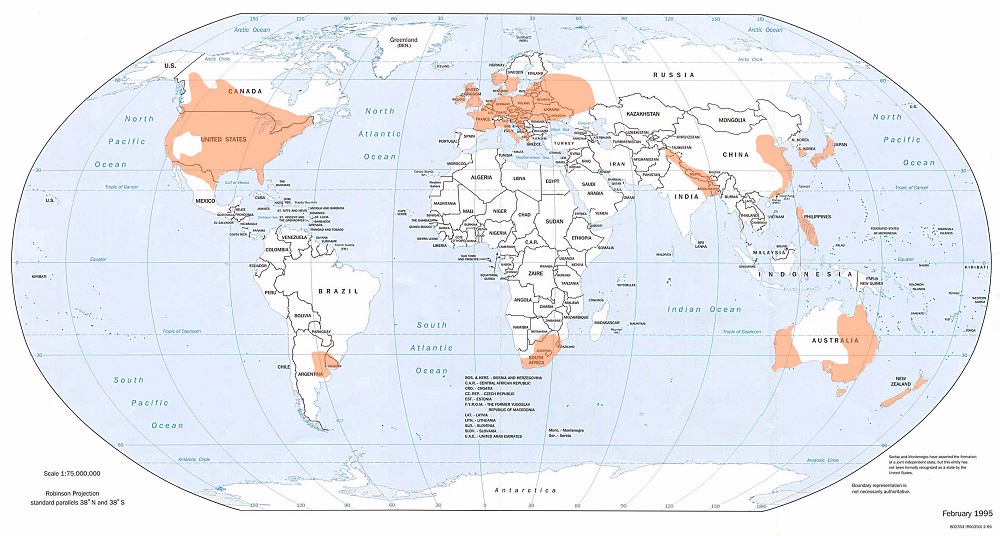
Below is a map describing global tornado incidence, from
http://www.ustornadoes.com/wp-content/uploads/2013/07/resized_global.jpg

While not far from Florida, a tornado hot spot, Haiti lies south of the tornado zone.
The incidence of tornadoes in the U.S. has increased over the last 30 years, but I suspect this could be due to increased population to report events and increased attention to and facilities for reporting. Global warming could be a contributing factor.
2. Hurricanes
Hurricanes require warm ocean temperatures greater than 80° F. to some depth (Ahrens states 6 meters is adequate), presence of the Coriolis effect, and converging moist surface air, from a tropical wave, the ITCZ as it moves north, or the remnants of a midlatitude storm. At 18.5° N latitude, with sea temperatures on the north coast of at least 84°F, and being in line for easterly tropical waves from the African coast, Haiti satisfies all these requirements for hurricane development. In fact, Haiti is brushed or hit by a hurricane every 3.74 years, and suffers a direct hit every 14.2 years, a frequency of 0.070 per year. http://www.hurricanecity.com/city/portauprince.htm
By comparison, the US, experiences on average 11.7 subtropical storms and 6.3 hurricanes yearly.
http://www.aoml.noaa.gov/hrd/tcfaq/E11.html
In Haiti, as in the tropical Atlantic and eaten Pacific, tropical cyclones are called hurricanes, while in the northern Pacific they are called typhoons, and in India and Australia they are called simply cyclones. Here is a map showing the regions of hurricane formation from http://www.wunderground.com/hurricane/?index_region=at

In the United States hurricanes usually travel toward the northwest from the southeast, due to the easterly trade winds moving them west and north around the subtropical high. They are then caught by the westerlies and they will curve to the northeast into the northern pacific.
Most tornadoes form from supercell thunderstorms, but some so-called nonsupercell tornadoes do not. Severe supercell thunderstorms require conditionally unstable air, forced to rise by topography, fronts or surface convergence, divergent air aloft, and wind shear, in direction and/or velocity, to initiate rotation of vortex tubes of air lifted up to form the rotating mesocyclone of the thunderstorm. This wind shear is often supplied by the polar jet stream aloft and a low level jet as well.
In the United States tornadoes tend to travel to the northeast because of southerly winds bringing in air from the Gulf and prevailing midlatitude westerly winds and the jet stream aloft. The average number of tornadoes reported annually in the united States is averages 1253.
http://www.ncdc.noaa.gov/climate-information/extreme-events/us-tornado-climatology/trends
I could not find a reference to the incidence of true tornadoes in Haiti, though recordings of "tornado-like" storms have been submitted by the public on YouTube and elsewhere.
http://humanitarian.worldconcern.org/2010/09/25/haiti-tornado/
https://www.youtube.com/watch?v=ctI_wb2c754&app=desktop
I would think tornadoes associated with supercell thunderstorms would be extremely rare in Haiti, since the polar jet stream necessary to create proper upper level conditions is so far north of Haiti, but possibly nonsupercell tornadoes could occur, such as sea or land spouts or gustnadoes.
Below is a map describing global tornado incidence, from
http://www.ustornadoes.com/wp-content/uploads/2013/07/resized_global.jpg
While not far from Florida, a tornado hot spot, Haiti lies south of the tornado zone.
The incidence of tornadoes in the U.S. has increased over the last 30 years, but I suspect this could be due to increased population to report events and increased attention to and facilities for reporting. Global warming could be a contributing factor.
2. Hurricanes
Hurricanes require warm ocean temperatures greater than 80° F. to some depth (Ahrens states 6 meters is adequate), presence of the Coriolis effect, and converging moist surface air, from a tropical wave, the ITCZ as it moves north, or the remnants of a midlatitude storm. At 18.5° N latitude, with sea temperatures on the north coast of at least 84°F, and being in line for easterly tropical waves from the African coast, Haiti satisfies all these requirements for hurricane development. In fact, Haiti is brushed or hit by a hurricane every 3.74 years, and suffers a direct hit every 14.2 years, a frequency of 0.070 per year. http://www.hurricanecity.com/city/portauprince.htm
By comparison, the US, experiences on average 11.7 subtropical storms and 6.3 hurricanes yearly.
http://www.aoml.noaa.gov/hrd/tcfaq/E11.html
In Haiti, as in the tropical Atlantic and eaten Pacific, tropical cyclones are called hurricanes, while in the northern Pacific they are called typhoons, and in India and Australia they are called simply cyclones. Here is a map showing the regions of hurricane formation from http://www.wunderground.com/hurricane/?index_region=at

In the United States hurricanes usually travel toward the northwest from the southeast, due to the easterly trade winds moving them west and north around the subtropical high. They are then caught by the westerlies and they will curve to the northeast into the northern pacific.

It was no surprise that Madagascar and Haiti share the fact that since storms do occur there it technically wouldn't be IMPOSSIBLE for there to be a tornado but due consistent temperature it not not likely for them to happen. I was surprised to learn that hurricanes do not hit Haiti at least once a year since it is near that Atlantic Ocean region that hurricanes form easily in. About 4 hurricanes hit Madagascar directly every year so just a bit more action than what Haiti receives.
ReplyDelete